




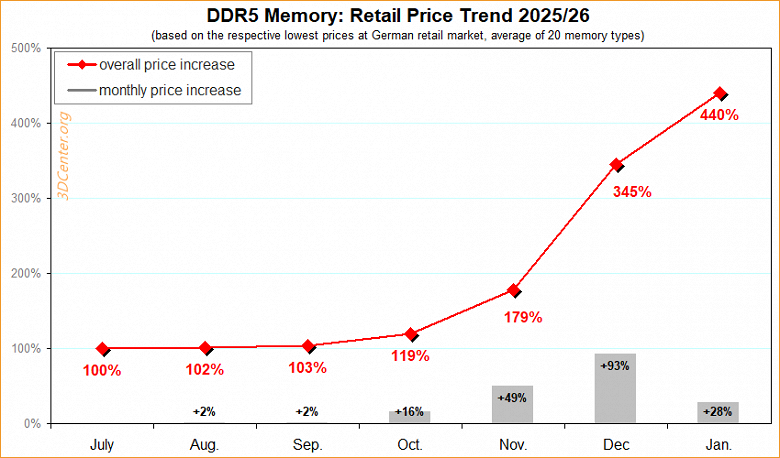
The European computer components market is experiencing an unprecedented price crisis. The analytical portal 3DCenter has released a fresh price index for RAM, based on data from the German aggregator Geizhals (excluding eBay and Amazon Marketplace offers). Statistics from mid-January 2026 show a catastrophic rise in RAM prices compared to July 2025 levels.
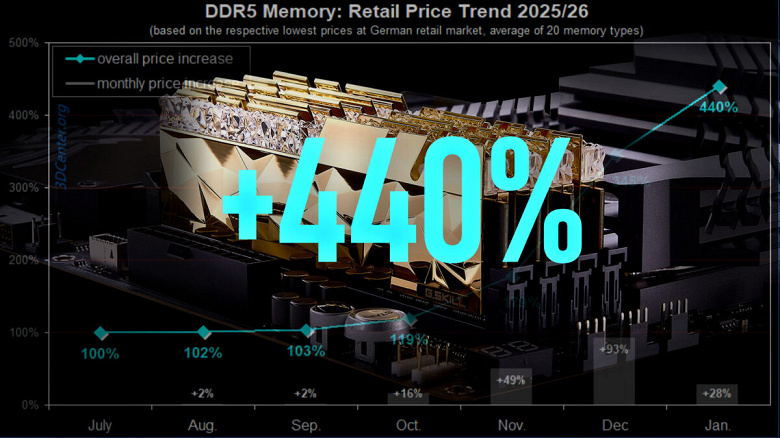
The strongest price surge hit DDR5 memory: on average, modules have increased by 340% compared to July 2025. Although the growth rate has slowed slightly (+27.6% from December 2025 to January 2026 versus +93% from November to December 2025), prices continue to climb.
For instance, a 2×32 GB DDR5-5600 kit increased in price from 530 EUR ($582) to 677 EUR ($743) in just one month (from December to January). Analysts emphasize the absurdity of the situation: the January markup of 147 EUR ($161) was higher than the full price of this kit six months ago (140 EUR or $154).
2×16 GB DDR5-6000 kits showed the largest percentage growth: from 75 EUR ($82) in the summer to 395 EUR ($433) now (+427%). Hopes to save on past generation builds (with DDR3/DDR4 memory) are evaporating. The average overcharge in this segment compared to July 2025 is 219% (a 3.2 times increase). In one month – from December 2025 to January 2026 – prices increased by 46.3%.
For example, a DDR4-2133/2400 module with 16 GB increased from 25 EUR ($27) to 87 EUR ($95) (+248%), and a similar module with 8 GB rose from 15 EUR ($17) to 60 EUR ($66) (+300%). Even outdated DDR3 memory, for which demand is minimal, shows growth: an 8 GB DDR3-1600 module rose in price by 75% (from 12 EUR or $13 to 21 EUR or $23), and a similar 2×8 GB kit by 104% (from 25 EUR or $27 to 51 EUR or $56).
Analysts at 3DCenter note that the crisis is not limited to RAM – significant price increases have also been recorded in the storage segment (both SSDs and HDDs).
Experts foresee that as we move deeper into 2026, the volatility in prices might stabilize slightly. However, upcoming tech releases and the continuing shortage of raw materials suggest sustained pressure on prices. Some speculate that manufacturers could pivot strategies, focusing more on technological advancements and diversifying sources to mitigate future crises.