





Modern data centers generate an enormous amount of heat and require substantial water resources to dissipate it. A new development by the Danish Technological Institute in collaboration with Heatflow and partners from Belgium and Germany demonstrates how this issue can be addressed by redirecting heat for further use.
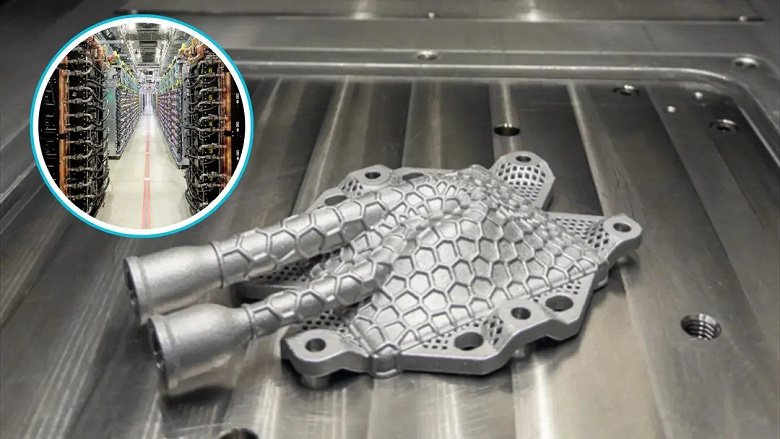
As part of the AM2PC project, engineers crafted a cooling system component 3D-printed from aluminum. This innovative system employs passive two-phase cooling based on the thermosiphon principle. The cooling fluid evaporates from the hot surface of a chip, naturally rises, condenses elsewhere, releasing heat, and then returns in liquid form under gravity. Pumps or fans are not required in this process.
This method dissipates heat more efficiently than air or single-phase liquid cooling, without consuming extra energy to transport heat. Initially, engineers predicted the solution would handle up to 400 watts of power, but tests revealed it manages 600 watts.
During its operation, the new system dissipates heat at temperatures from 60-80 degrees Celsius, considerably above traditional systems. This means that excess heat can be directly fed into centralized heat supply networks without additional energy costs.
Additional Insights and Recent Advances
Recent advancements in data center cooling technologies emphasize the growing importance of sustainability and energy efficiency. Companies are exploring materials like graphene and advanced heat exchangers to further improve thermal management. In January 2026, reports surfaced highlighting advancements in nanofluid cooling systems, which may complement existing solutions by offering enhanced thermal conductivity and heat transfer capabilities.
Moreover, competitors in the industry are increasingly focusing on hybrid cooling solutions that integrate both liquid and air cooling techniques to maximize efficiency and reduce environmental impact.
“As data centers continue to scale, thermal management becomes a critical competitive edge,” remarked a leading industry expert. “Innovations like these ensure that our digital infrastructure remains robust and sustainable.”
This innovative strategy aligns with the global shift toward eco-friendly technologies that prioritize both performance and environmental impact, ensuring that digital infrastructures evolve sustainably as demands on data centers grow exponentially.