






Researchers at the University of Amsterdam (UvA) have proposed using gravitational waves to study dark matter – a substance estimated to make up about 65% of the universe’s mass. The authors have developed an improved model for the influence of dark matter on gravitational waves formed by black hole mergers. Their model describes how dense clusters of dark matter around massive black holes can imprint on gravitational waves generated by events called EMRIs (Extreme Mass-Ratio Inspirals) – the spiraling and merging of black holes or other compact objects with extreme mass differences.
This new research utilizes general relativity rather than Newtonian gravity to describe the influence of a black hole’s environment on an EMRI orbit and therefore on gravitational waves. This marks the first fully relativistic model for predicting gravitational waves caused by black hole mergers.
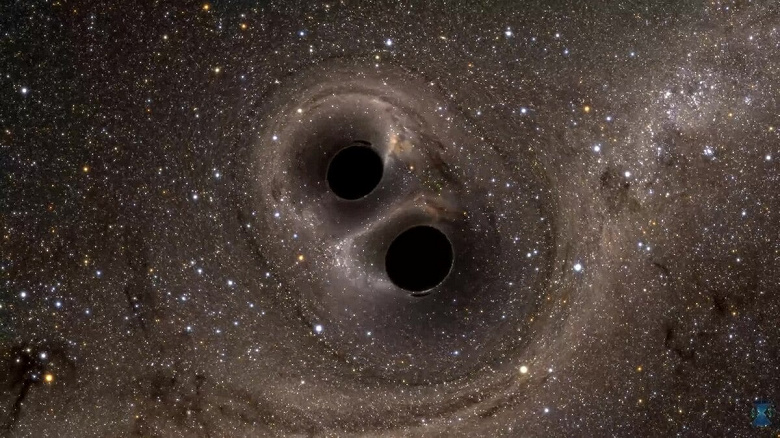
Particular attention has been paid to the dense concentrations of dark matter, which may form around massive black holes. The team has shown how these “dark matter spikes” would leave a distinctive mark on gravitational wave signals. This research comes amidst a series of innovative analyses using gravitational waves to map dark matter distributions across the universe, starting to clarify its nature and the mysterious makeup of this mass.
The new approach is expected to be applied in data analysis from the upcoming LISA (Laser Interferometer Space Antenna) mission of the European Space Agency (ESA), set to launch in the coming decade. LISA will be the first space-based observatory designed specifically to study gravitational waves. It will consist of three spacecraft using six lasers to measure ripples in spacetime. Anticipations are high that the observatory will detect over 10,000 gravitational wave signals during its mission. Recent suggestions have pointed to an enhanced scale of detection ranges and potentials, inspiring further interest and expectations in the astrophysical community.