



Researchers from Ohio State University conducted an unusual experiment: they tested whether mushroom mycelium can operate on the principle of computer memory-similar to memristors, which are considered as an alternative to traditional DRAM. The experiment utilized shiitake and oyster mushroom mycelium. Scientists cultivated the mycelium on an organic substrate, then dehydrated it, shaped it, and connected electrodes. The samples were quickly rehydrated to restore biological activity and subjected to electrical signals of varying shapes and voltages.
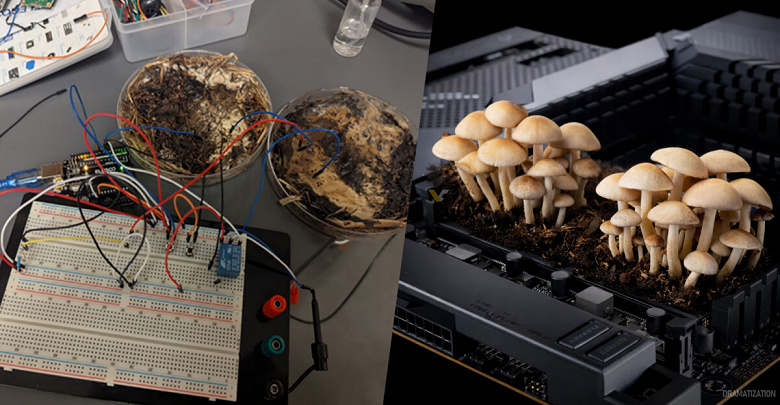
The results were unexpected: at approximately 1 volt, the mycelium exhibited the most stable behavior, and its electric resistance “remembered” the previous state. In specific tests, scientists managed to make the mushroom structure work almost like RAM-with a frequency up to 6 kHz and accuracy around 90%. The mycelium was grown in Petri dishes on a blend of grain, wheat germ, and hay at a temperature of 20–22°C and humidity of 70%. Before measurements, samples were sun-dried for a week. Conductivity was restored by lightly spraying with deionized water, with electrodes connected to an oscilloscope.
However, the authors emphasize: real data storage is not yet in question. Memory volumes, stability, storage density, and interfaces are far from the requirements of modern electronics. Even using entire “mushroom farms,” they cannot replace traditional RAM. Nonetheless, the study shows that living and biological materials might possess properties beneficial for future computing systems-particularly in niches of cheap, experimental, or non-standard electronics.
New Horizons in Bio-Electronics
Recent breakthroughs have seen the use of proteins and DNA as potential elements for data storage or circuit design. Innovations like bacterial nanowires in bio-computing circuits are notably trending due to their conductive properties and renewable nature. These innovations contribute to global sustainability by reducing energy consumption and the use of raw materials compared to traditional electronics.
Future Forecasts and Challenges
Forecasts for using biological materials in computing anticipate their application in specialized devices, such as environmental monitors or low-power sensors, within the next decade. For mainstream consumer electronics, significant breakthroughs in scalability, data density, and stability are essential. Continuous research is vital in overcoming integration challenges with existing technologies and ensuring consistent performance, paving the way for these promising yet fledgling technologies.