





On the first day of 2026, gamers using Steam with the 32-bit version of Windows will find themselves without support from Valve. On January 1, the company will cease support for the 32-bit Steam client on Windows 10/11. This announcement came through an update released on December 19.
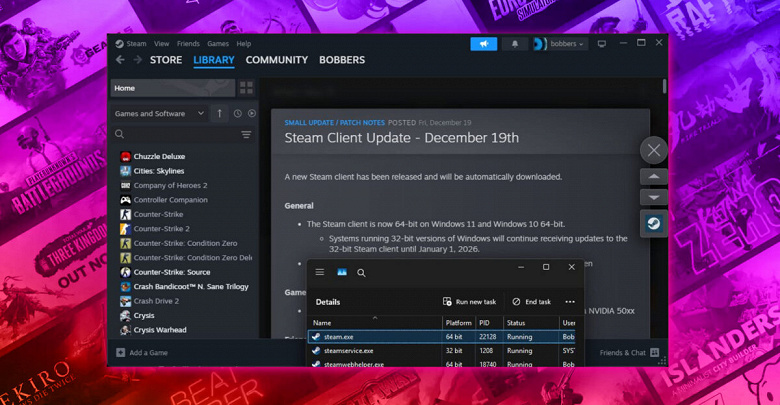
In this update, Valve has already transitioned the Steam client to a 64-bit version for the corresponding Windows systems, simultaneously revealing that the 32-bit version will receive updates only until January 1, 2026-just under two weeks away. For the majority of gamers, this isn’t a major issue, since, according to Valve’s own statistics, only about 0.01% of Steam gamers use the 32-bit version of Windows 10. Nevertheless, this still accounts for tens of thousands or even hundreds of thousands of users who now need to consider upgrading their OS.
Of course, once support ends, the client itself will continue to function, but its stability over time remains uncertain.
Advancements in 64-bit Adoption
The transition towards 64-bit technology has been steadily accelerating, becoming the standard across industries due to its ability to handle more RAM, improve performance, and support more complex applications-essential particularly in gaming and tech innovation fields.
Recent advancements have marked a major shift, with game developers increasingly leveraging the power of 64-bit architecture to enhance game detail and performance. The overwhelming push towards 64-bit programs aligns with a broader industry trend where technology firms aim for more robust systems capable of supporting demanding computing tasks, thus phasing out obsolete systems.
Impact on the Gaming Community
While the cut-off may seem abrupt to some, Valve’s move reflects a necessary evolution in computing standards. Users sticking to 32-bit systems are likely fewer in numbers than before, showing how user’s preferences lean toward embracing more powerful, future-ready platforms. For those affected, it represents an opportunity to upgrade and experience improved security and capabilities that 64-bit systems offer.
Industry experts note that such shifts are indicative of evolving market expectations, where maintaining outdated technologies no longer sustains the competitive edge companies seek. With this transition, gamers and developers alike can look forward to a future enriched by innovations that harness the full potential of modern computing resources.