







Future Intel Nova Lake processors have become fairly well understood thanks to multiple leaks. However, there is significantly less information about upcoming Ryzen processors on the Zen 6 architecture. Fortunately, AMD itself has published a document from which some new insights can be gleaned. For example, Zen 6 will not be an improvement of the Zen 4/5 architectures. It is a completely new architecture with new emphases and features. Recall that Zen 5 differs from Zen 4 mainly in significantly improved energy efficiency.
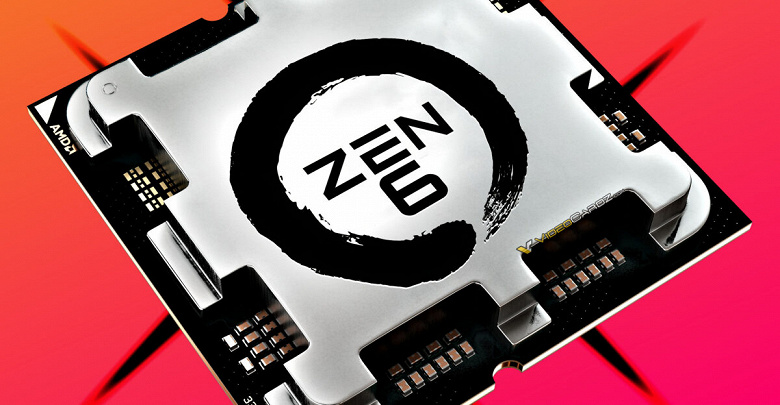
The document states that processors with up to 256 cores will be released on the Zen 6 architecture, but this, of course, only concerns server Epyc processors. The 2 nm process from TSMC will probably not apply to all CPUs on the new architecture, as AMD is already negotiating with Samsung regarding the production of Epyc Venice, but also on the 2 nm node. A new highlight of Zen 6 is its focus on chip-internal bandwidth with an eight-slot dispatch mechanism. In this design, two hardware threads dynamically compete for a common dispatch slot pool, so with equal clock speeds, the single-threaded performance of processors based on Zen 6 may not be as high as some competitors. However, in certain scenarios, this type of architecture promises very high performance.
Furthermore, the core has dedicated counters for unused dispatch slots, backend delays, and losses in thread selection. Zen 6 also significantly expands AMD’s capabilities in vector calculations and floating point arithmetic, emphasizing the architecture’s focus on complex mathematical tasks. Zen 6 supports full-scale AVX-512 execution with FP64, FP32, FP16, and BF16 data formats, including FMA/MAC operations and mixed vector execution FP-INT (including VNNI, AES, and SHA class operations). All this may suggest that AMD is creating Zen 6 with a strong focus on use in the server segment. It is clear that Epyc has always performed well, but here we may expect an even greater performance boost.
In terms of the consumer segment, remember, leaks hint at a 24-core flagship of the new generation. Additionally, the use of the advanced 2 nm process by TSMC is expected to significantly enhance power efficiency and transistor density, positioning Zen 6 as a front-runner in computational power and efficiency, potentially outpacing current competitors like Intel’s Meteor Lake series.