
Data centers demand vast amounts of water for cooling, posing challenges for many regions. The hotter the area where a data center (DC) is situated, the more intensive the cooling required for facilities and chips. The authors of Rest of World decided to examine how rationally from this perspective data centers are constructed worldwide. The study showed that many facilities are built in climates far from ideal for such tasks. For instance, in Singapore, the average annual temperature hovers around 91°F (33°C), with humidity exceeding 80%.
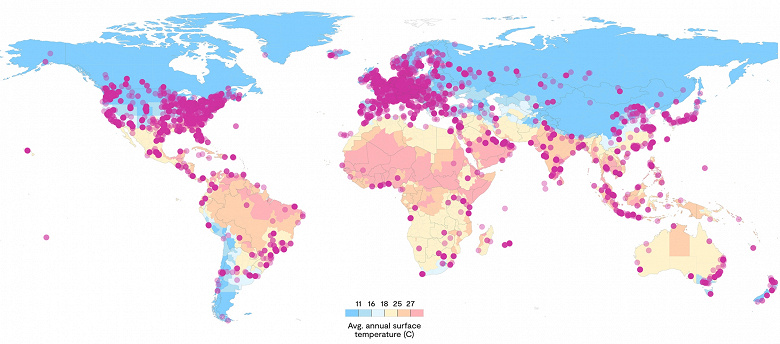
Authors calculated that today there are 8,808 DCs globally, and in five years, this number will triple due to the AI boom. The ideal temperature range for data centers is between 64°F and 81°F (18°C to 27°C), but only a small portion of facilities are in such regions. More precisely, nearly 7,000 DCs are located outside the optimal range, and only 600 facilities, or less than 10% of all operating data centers, are situated in areas where the average annual temperature doesn’t exceed 81°F. It’s also noteworthy that in 21 countries, all DCs are positioned in zones where the average temperature surpasses this range. These are countries in the equatorial zone worldwide: Africa, Latin America, and Southeast Asia. Almost half of Indonesia’s 170 data centers are in hot regions, while in India – a key market for major technology and social media companies – about 30% are located in regions with excessively high temperatures.
Rising Challenges and Cooling Innovations
As data centers continue to proliferate, driven by the AI explosion, new cooling technologies are being explored. Innovations like immersion cooling, which submerges servers in special non-conductive liquids, are gaining traction, particularly in overheating regions. Furthermore, the industry is moving towards adopting renewable energy sources to power these energy-intensive facilities, thus reducing the environmental impact.
AI’s Role in Data Center Expansion
The growth of artificial intelligence is a significant factor behind the increasing number of data centers. AI applications require substantial computational power, leading to a surge in demand for data processing capabilities. This demand is reshaping the landscape, compelling companies to set up operations in locations previously deemed unsuitable due to climatic challenges.