
In December, the interstellar comet 3I/ATLAS will approach Earth at a minimal distance of about 270 million kilometers. This event has garnered the attention not only of space agencies but also of the United Nations. The International Asteroid Warning Network (IAWN), coordinated by NASA, is using this close approach to test new methods for accurately determining the coordinates of comets and asteroids. IAWN, which brings together over 80 observatories and amateur scientists worldwide, began its observation campaign for 3I/ATLAS in October. According to James Bauer, head of the small bodies segment at IAWN and a professor of astronomy at the University of Maryland, observation results will be published in 2026. The campaign aims to refine astrometry methods, which involve measuring the coordinates of celestial bodies. This data is crucial for predicting the trajectories of potentially hazardous objects and planning future missions to comets.
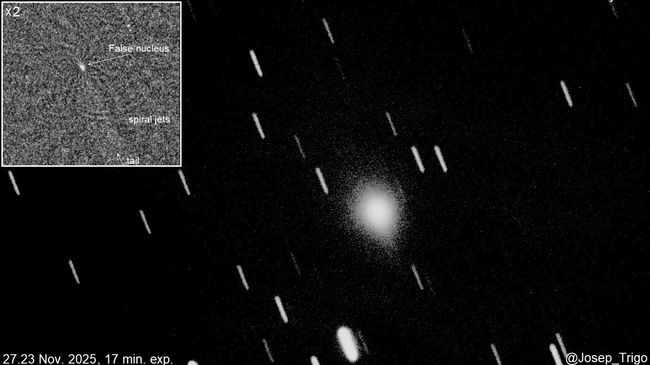
The UN recently increased its focus on tracking interstellar objects, collaborating with international space agencies to enhance global security regarding potential space hazards. The 3I/ATLAS has become the first interstellar object tracked by IAWN within such campaigns, initiated in 2017. Previously, in 2020 and 2021, the network observed the potentially hazardous asteroid Apophis. A new campaign to monitor it is planned for 2027-2029, when the asteroid will safely approach Earth. Despite its interstellar origin, 3I/ATLAS shows classical behavior. It contains components such as water and carbon dioxide, behaving similarly to Solar System comets. However, accurately measuring the comet’s position is challenging due to the variability of its brightness and its coma-a cloud of gas and dust surrounding the comet’s nucleus. These factors can distort the visible size of the comet and make it difficult to determine its location. High interest in the campaign has been shown by both professional astronomers and amateurs. IAWN’s launch meeting in October recorded a record number of participants-171. At a teleconference in December 2025 dedicated to interim results, approximately 100 people were present. Scientists provide support to participants by answering questions about observation methods and the format for data submission. Observations of 3I/ATLAS will improve methods for determining the coordinates of celestial bodies, increasing the efficiency of detecting and tracking potentially dangerous asteroids and comets approaching Earth. In turn, this is important for ensuring our planet’s safety from space threats.