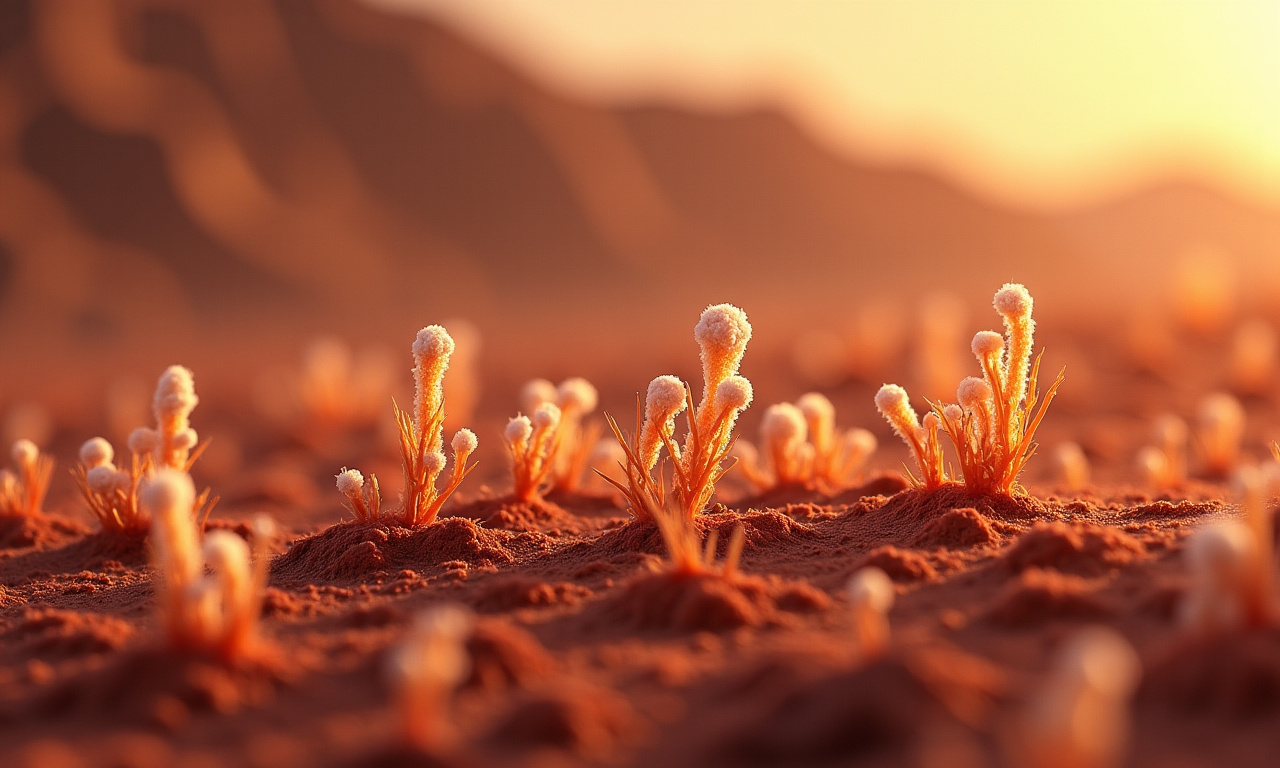

Scientists have revealed the results of cultivating Serratia liquefaciens bacteria under conditions that mimic the Martian atmosphere. The bacteria were cultured for 28 days at a pressure of 7 mbar (approximately 0.007 atmospheres), a temperature of 0°C, and in a carbon dioxide-rich, oxygen-free atmosphere. For comparison, a control group of bacteria was grown under Earth-like conditions: at a pressure of 1013 mbar (1 atmosphere), a temperature of 30°C, and a standard nitrogen-oxygen ratio.
Serratia liquefaciens is a bacterium widely found in soil, water, and on plants, known for its ability to survive in cold and nutrient-poor environments. Due to this “stress resistance,” it is often used as a model organism for studying how microbes adapt to extreme conditions.
Analysis using electron microscopy showed that bacterial cells grown in earthly conditions had uniform shape and size, averaging about 1.25 μm in length and 0.5 μm in width. On the surface of 10–20% of cells, fimbriae were observed-thin thread-like structures that help bacteria attach to surfaces.
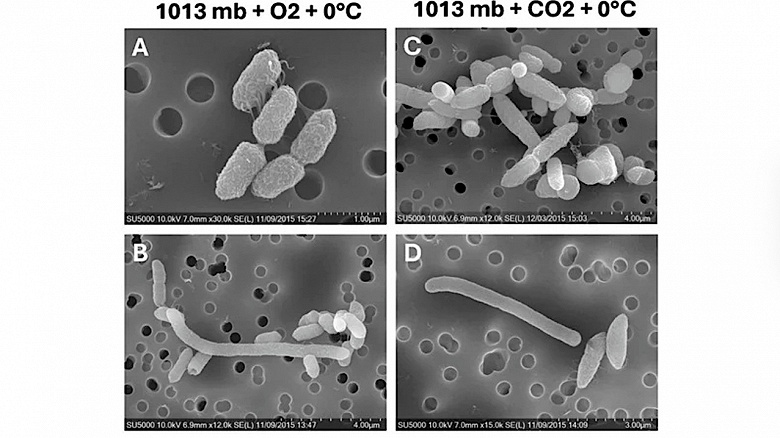
Images display changes in the cell wall thickness of Serratia liquefaciens in different conditions. (A) When grown in laboratory conditions for 24 hours, the average wall thickness was about 29.4 μm. (B) When cultivated in “Martian conditions” for 28 days, the walls became noticeably thinner-approximately 24.3 μm.
However, cells grown under conditions mimicking Martian ones showed significant deviations. Firstly, cell ends undergoing division were swollen and blunt, while distal ends (opposite from the division site) had unusually narrow whips. Secondly, the process of cell division was disrupted: division planes often positioned at non-standard angles, leading to daughter cells oriented at right angles to each other. Thirdly, some cells did not form division planes, resulting in long, spiral, and deformed cells up to 6–8 μm in length. Finally, bacteria grown in Martian conditions lacked fimbriae.
It was also found that the cell walls of bacteria grown under low pressure and temperature conditions were about 17% thinner than those of bacteria grown in standard laboratory conditions. These results are significant for astrobiology and the search for life beyond Earth. Changes in the shape and structure of S. liquefaciens cells under Martian conditions underscore that microorganisms can adapt to extreme conditions, but their morphology can change significantly. This must be considered when analyzing samples obtained from other planets, not to miss signs of life based on “terrestrial” notions of what microorganisms should look like. The data obtained will help develop more precise criteria for searching and identifying extraterrestrial life, considering possible morphological changes in microorganisms in extreme conditions.
Recent advancements have further highlighted the adaptability of microorganisms in space-like conditions. Studies are exploring how extremophiles, organisms that thrive in extreme environments, might contribute to future technologies in bioengineering and space exploration. The insights from S. liquefaciens’s resilience could drive new research on life-support systems and biologically based resource management for prolonged space missions.