
An international team of scientists has combined observations from several telescopes to achieve the necessary resolution for directly observing the swift explosions of nova stars. A nova event occurs in a binary system when a white dwarf, a dense stellar remnant, siphons material from its companion star. As a result, thermonuclear reactions begin on the surface of the white dwarf, leading to a dramatic increase in the star’s brightness. “The data obtained allows us to closely see how material is ejected from the star during the explosion,” says Gail Schaefer, Director of the CHARA Array and co-author of the study. “Observing these fleeting events requires adapting our observation schedule as new and interesting targets are discovered.” Until recently, astronomers could only infer the early stages of these explosions indirectly, and the expanding material appeared as a single flash.
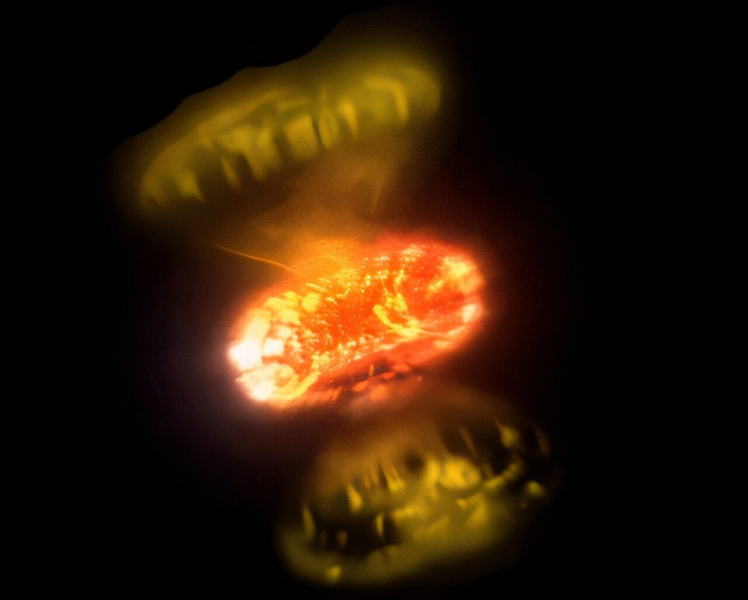
Scientists observed two different novas that exploded in 2021. One of them, Nova V1674 Herculis, turned out to be one of the fastest ever recorded: it flared up and faded away in just a few days. Images revealed two distinct perpendicular streams of gas, indicating that the explosion was triggered by multiple interacting ejections. Notably, these new jets appeared in images simultaneously as NASA’s Fermi Gamma-ray Space Telescope detected high-energy gamma rays, directly linking the shockwave emission to jet collisions. The other nova, Nova V1405 Cassiopeiae, evolved more slowly. It surprised astronomers by holding onto its outer layers for more than 50 days before finally shedding them, which became the first clear evidence of a gradual development process. When the material was eventually ejected, it caused new shockwaves, which were also recorded by Fermi.

“This data allows us to observe a star explosion in real-time, which is very difficult and long considered extremely challenging,” says Elias Aydi, lead author of the study. “Instead of seeing just a flash of light, we now uncover the true complexity of how explosions develop. It’s like moving from a grainy black-and-white photo to high-definition video.”
Findings not only reveal unexpected complexity in the evolution of novas but also help explain their powerful shockwaves, which produce high-energy radiation. The data challenges the long-held belief that nova eruptions are singular, impulsive events. Instead, they indicate a diversity of ejections, including multiple outflows and delayed shell shedding.