
Galaxy Z TriFold, Samsung’s first smartphone that folds into three, has been officially unveiled – and according to the company, it doesn’t seem like an experiment at all. In a new video, Samsung illustrates how the device is assembled and tested for durability.
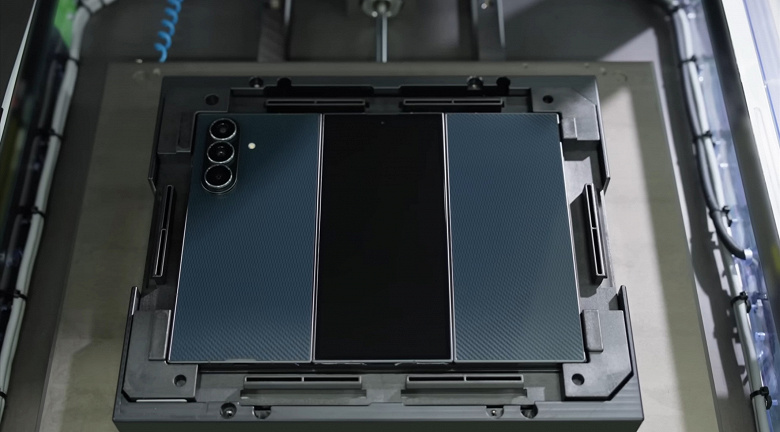
The smartphone’s body consists of three sections connected by Samsung’s trademark Armor FlexHinge. The assembly process is fully automated and includes precision alignment of parts. A new gluing method is then applied, making the surface of the frame impeccably smooth. This smoothness is confirmed through laser scanning.
Afterward, a 10-inch foldable OLED panel is attached to the body, pressed for a specified time – the structure becomes thinner and stronger. The back panel is also glued using pressing. A volumetric laser scanning system then confirms the perfect alignment of all elements in the construction.
Robotic arms ensure the smartphone opens to a full 180 degrees. Upon opening, a scanner analyzes the hinge operation and the condition of the flexible display. Another automated rig repeatedly folds and unfolds the device as part of a durability test. Samsung claims the Galaxy Z TriFold is designed for 200,000 folding cycles – which equates to 100 openings per day for five years. The same claim is made for the Galaxy Z Fold 7.
All cameras undergo autofocus and optical quality testing. The display is tested for color accuracy, brightness, and touch screen sensitivity. Connectivity and wireless modules are tested under different conditions. Galaxy Z TriFold has an IP48 rating for dust and water resistance, capable of withstanding submersion up to 1.5 meters (5 feet) for 30 minutes.
With its combination of declared characteristics, the intricate Galaxy Z TriFold demonstrates a level of theoretical reliability comparable to the Galaxy Z Fold 7. However, Samsung is confident that this theoretical reliability aligns perfectly with practical performance.