

Scientists have detected signs of cryovolcanism – eruptions of ‘ice volcanoes’ – on the surface of the interstellar comet 3I/ATLAS. This discovery suggests that the comet’s composition resembles that of icy trans-Neptunian objects (TNOs) – dwarf planets and other bodies beyond Neptune’s orbit.
Astronomers have been closely observing comet 3I/ATLAS since its discovery in July. The comet is only the third registered interstellar object, offering a unique opportunity to study the conditions that existed in other stellar systems billions of years ago.
During the observation, scientists used the Joan Oro telescope at the Montsec Observatory in Spain and other observatories to monitor the comet as it approached the sun. On October 29, the comet reached perihelion – the point of closest approach to the sun. As it neared the star, surface ice on the comet began to sublimate into gas, allowing scientists to study the comet’s composition.
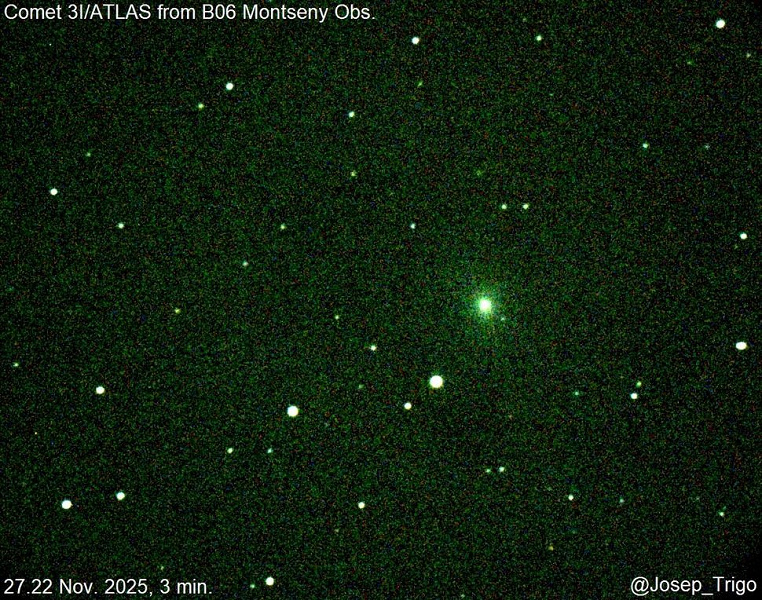
Astronomers recorded intensified sublimation as the comet approached the sun to a distance of 378 million kilometers. High-resolution images showed gas and dust emanating from the comet, interpreted as signs of cryovolcanism. Cryovolcanoes are usually found on ice-rich bodies such as trans-Neptunian objects. On TNOs, internal heat causes ice to melt, leading to eruptions of cryovolcanoes ejecting vapor and dust into space.
In the case of 3I/ATLAS, scientists believe that cryovolcanism is caused by the corrosion of primordial material trapped within the comet. Under solar heat, solid carbon dioxide began to sublimate, allowing oxidizing liquid to penetrate the comet’s interior and react with nickel and iron sulfides.
To test this hypothesis, a spectroscopic analysis of the comet and samples of carbonaceous chondrites collected by NASA in Antarctica was conducted. The analysis showed that 3I/ATLAS has a similar composition to these meteorites and is likely rich in metals.
Despite its compositional similarity to carbonaceous chondrites and behaviors akin to trans-Neptunian objects, the trajectory of comet 3I/ATLAS indicates its extrasolar origin. The comet travels at a speed of 137,000 mph, too fast to be gravitationally bound to the sun. Research results show that, despite its interstellar origin, comet 3I/ATLAS shares much in common with objects in the Solar System. This conclusion provides new information about the formation and composition of comets, as well as processes occurring in other stellar systems.